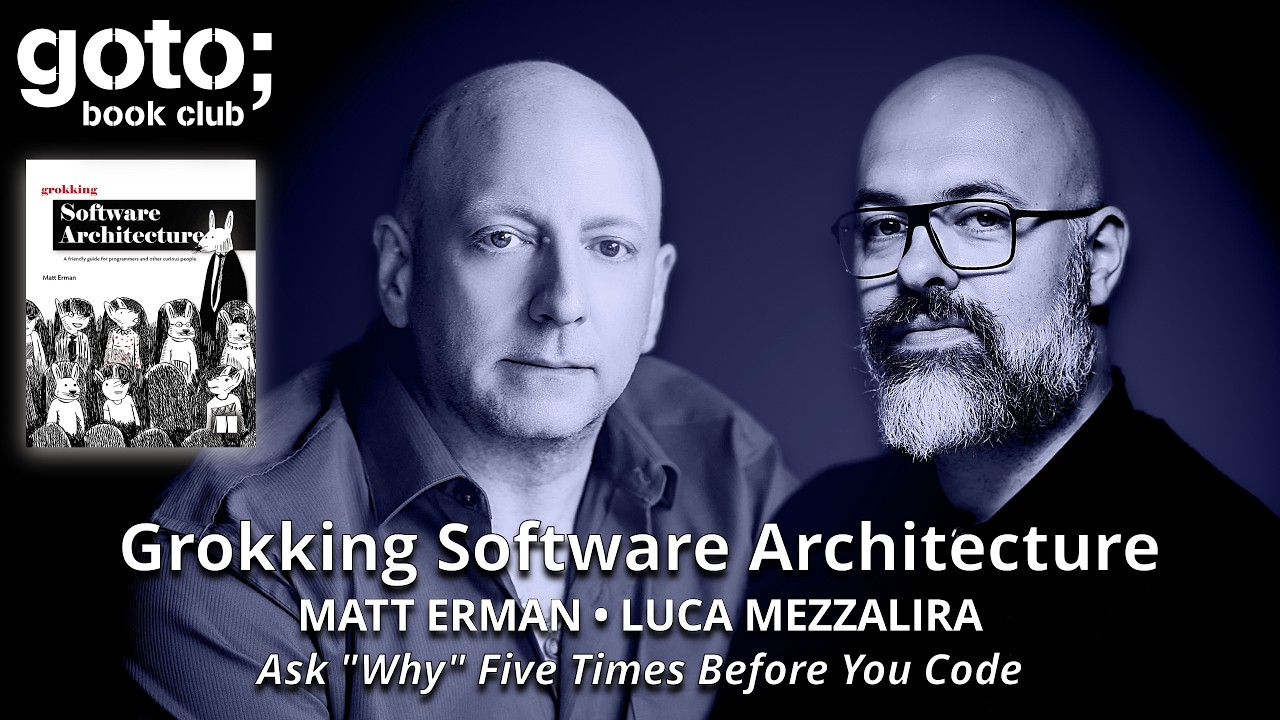
Grokking Software Architecture • Matt Erman & Luca Mezzalira • GOTO 2026
Title history
- Grokking Software Architecture • Matt Erman & Luca Mezzalira • GOTO 2026 — observed on 20261029-0925 UTC (YouTube)
Keywords
Summary
250 words
Critical Evaluation
Value of the Information & Strength of the Argument
The video offers substantial practical value for software developers and architects. It presents a clear, actionable five-step process for architectural thinking, grounded in established methods like the Five Whys and ADRs. The argument that AI amplifies existing skill levels is compelling and well-illustrated with concrete examples, such as the risk of “Frankenstein code” when AI combines patterns without clear constraints. Erman’s emphasis on communication as a core architectural skill is logical, and he supports it with the observation that the best-communicated idea often wins, not necessarily the best one. The discussion about Hyrum’s Law adds an important nuance regarding API contracts. The reasoning is coherent and consistent throughout, with each claim tied to practical experience or recognized principles. While the conversational format limits the depth of any single topic, the overall argumentation is solid and thought-provoking.
Scientific Rigor, Source Quality, Title Accuracy
The scientific rigor is moderate; the content is based on expert opinion rather than peer-reviewed research, but it references established concepts (Five Whys, ADRs, Hyrum’s Law) and integrates them coherently. The sources provided in the description include the author’s blog, the book link, and the episode page, which are legitimate and directly relevant. The title matches the content accurately; the interview is directly about the book and its core ideas. No discrepancies were observed between the title and the actual discussion.
232 words
Title / Content Match
The title accurately reflects the content, which discusses the book and its core ideas about software architecture in the context of AI.
Quality & Reliability
8/10
The interview provides practical, experience-based advice on software architecture and incorporates established concepts such as Architectural Decision Records and the Five Whys. The arguments are coherent and well-articulated, although the conversational format limits depth.
Chapters
- Intro
- Why fundamentals are going missing
- Architects as "clarity engineers"
- Soft skills win architecture debates
- The 5-step architectural thinking process
- ADRs: Architectural Decision Records
- "AI told me to" is not a defense
- Your API schema is the system prompt
- Will AI replace architects?
- Advice for the next 6 months
- Outro
Cited Sources
- GOTO Book Club — The video is part of the GOTO Book Club series.
- Grokking Software Architecture (book) — The book discussed in the interview.
- Episode page — Official episode page for this interview.
- Matt Erman's blog — Author's blog with additional resources.
- Luca Mezzalira's website (Building Micro-Frontends) — Luca's site about his book and work.
Concurring Sources
- Grokking Software Architecture (book) — The book expands on the concepts discussed in the interview.
- Episode page — Official episode page with additional details.
External References
Contribution & Novelties
The interview introduces the concept of the architect as a ‘clarity engineer’ and presents a five-step architectural thinking process. It emphasizes that AI amplifies existing developer skills and warns against the erosion of fundamentals. The discussion on ADRs and Hyrum’s Law in the context of AI offers a practical perspective.
Pour aller plus loin :
- Hyrum’s Law — Understanding why every observable behavior becomes a contract.
- Architecture Decision Record — A method to document architectural decisions.
- Five Whys — Root cause analysis technique from Toyota.
85 words
Radar Profile
The radar shows a balanced profile with high scores in quality and reliability, reflecting the expert's clear articulation of ideas. The technical level is moderate, suitable for a broad engineering audience, while the quantity of information is adequate given the interview format.