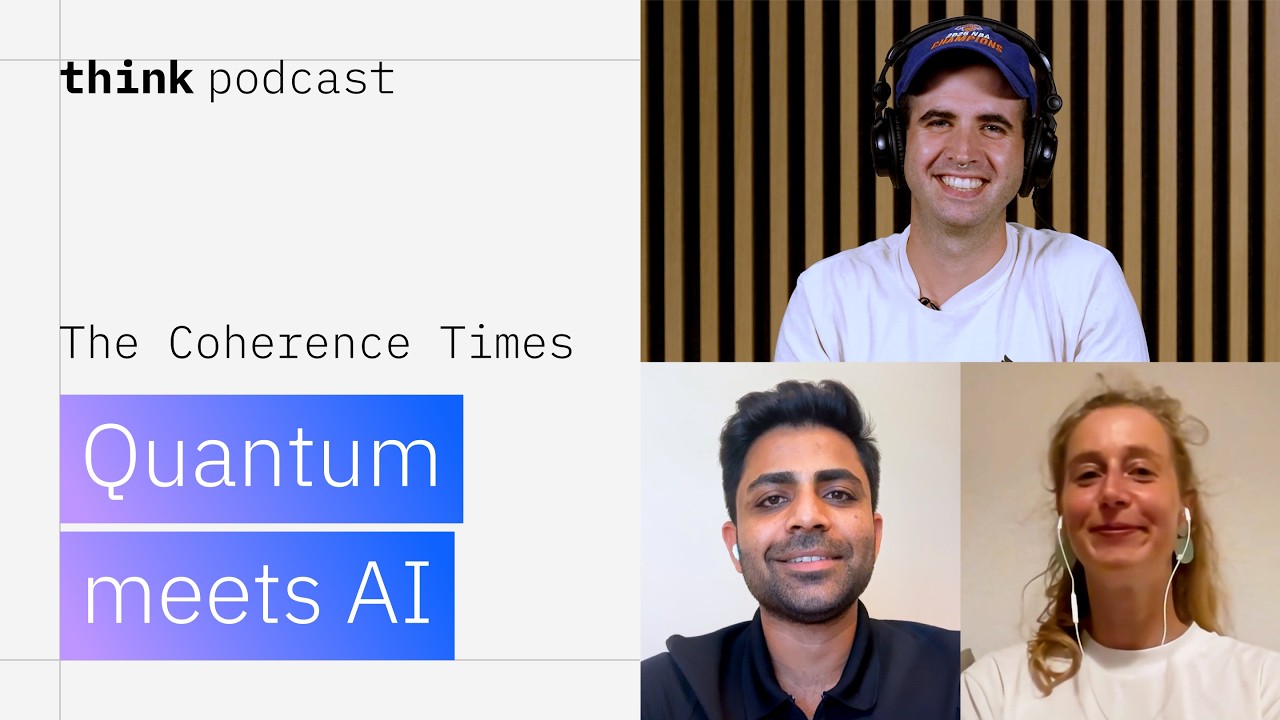
What is quantum machine learning, really?
Title history
- What is quantum machine learning, really? — observed on 20261027-1251 UTC (YouTube)
Keywords
Summary
168 words
Critical Evaluation
Value of the Information & Strength of the Argument
The information provided is valuable for understanding the current landscape of QML. The guests effectively break down the field into three main categories and offer concrete examples, such as using quantum to generate features for material classification or employing AI to design dynamic circuits. The argumentation is balanced: they acknowledge hype versus reality, clearly state when results are speculative, and emphasize that quantum advantage is not yet demonstrated. The discussion of quantum data slowness is particularly insightful, as it tempers overexpectations. The episode does not present a single thesis but explores multiple angles, and the logical flow is coherent.
Scientific Rigor, Source Quality, Title Accuracy
The scientific rigor is high for a podcast. Both guests are active researchers, and they carefully separate established knowledge from open problems. They reference ongoing projects and cite general areas of research without giving specific publication names, which is typical for a discussion format. The only explicit source provided is the IBM Quantum Platform link, which serves as a resource for further learning. The title accurately corresponds to the content, as the entire episode seeks to define what QML truly entails. No comments were available to analyze, so public reception is not addressed.
207 words
Title / Content Match
The title accurately reflects the core question explored in the podcast, which investigates the definition and potential of quantum machine learning.
Quality & Reliability
8/10
The episode features two established researchers in quantum computing and machine learning, providing a balanced and informed discussion. Claims are generally speculative or framed as open research questions, avoiding overstatement. The description includes a link to IBM Quantum Platform for further learning.
Key Moments
Markers derived by PSI from the transcript: the creator did not define chapters.
- Introduction and the question of when quantum LLMs will exist; Kunal and Zoe respond that scalable trainable quantum models are still lacking.
- Definition of machine learning in the context of quantum, and the three buckets: quantum for ML, AI for quantum, and hybrid approaches.
- Discussion on the slowness of quantum computers for generating data, and the implications for using quantum data in AI.
- Overview of variational quantum circuits and quantum kernels, including how they work and their potential promise.
- Speculative applications: using quantum to generate novel features for material science, and the role of Hamiltonian learning.
Cited Sources
- IBM Quantum Platform — Provided in the video description as a resource to learn more about quantum computing and quantum machine learning.
Contribution & Novelties
The episode offers a clear and nuanced perspective on the current state of quantum machine learning, correcting common oversimplifications. It emphasizes the slowness of quantum data generation as a key bottleneck and distinguishes between different ways quantum and AI can interact. The guest researchers share insider views on ongoing efforts to use AI in quantum algorithm design.
Pour aller plus loin :
- Quantum machine learning - Wikipedia — Provides a broad overview of the field, including algorithms and challenges.
- Variational quantum eigensolver - Wikipedia — Explains a specific variational algorithm relevant to the discussion of parameterized quantum circuits.
- Quantum kernel methods - Wikipedia — Detailed overview of kernel-based quantum machine learning, a key topic discussed in the episode.
118 words
Radar Profile
The radar profile shows relatively high scores in quality, quantity, and reliability, with a slightly lower technical level. This indicates the video is a well-informed discussion that is accessible to a broad audience, but not extremely deep technically.