FAIR Workflows and Data Accelerating AI-Driven Research
Title history
- FAIR Workflows and Data Accelerating AI-Driven Research — observed on 20261106-1538 UTC (YouTube)
Keywords
Summary
216 words
Critical Evaluation
Value of the Information & Strength of the Argument
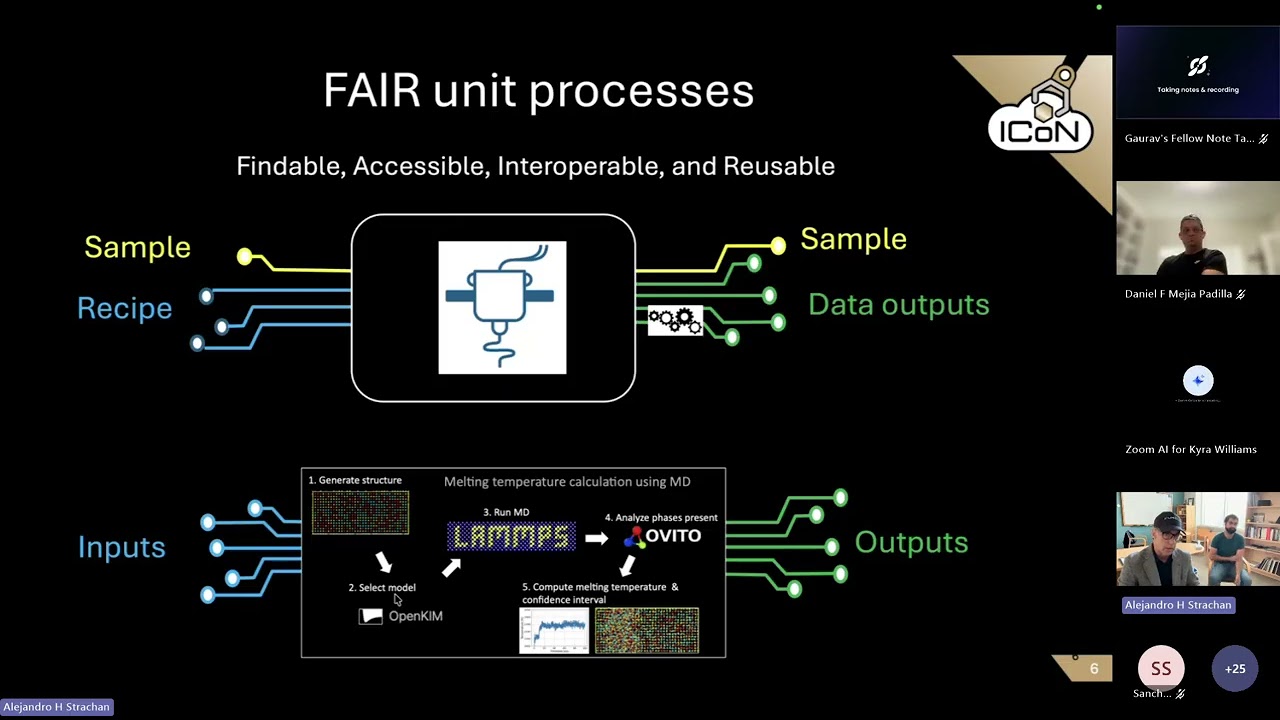
The information provided is substantial and valuable, offering a concrete, real-world implementation of AI-driven research infrastructure. The argumentation is strong because it is based on deployed systems with measurable outcomes, such as the melting temperature optimization example where reuse of FAIR data reduced simulations from 14 to 2. The speakers logically build the case for FAIR workflows and AI agents by showing how each component (tool publication, metadata, MCP, agent architecture) contributes to the overall goal. The examples are clear and tied to actual use cases, enhancing credibility. However, the talk is primarily a demonstration of their own platform, so the argumentation could benefit from independent evaluation or comparative studies.
Scientific Rigor, Source Quality, Title Accuracy
The scientific rigor is reasonable; the presenters are from leading institutions and describe a long-established platform (nanoHUB) with extensive usage. They mention standards like FAIR and MCP, and they reference published tools and data with DOIs, which lends credibility. The title is well-matched to the content: the video focuses on FAIR workflows and data and how they accelerate AI-driven research. No external sources are cited beyond their own platform, but the internal references to their own published work are appropriate. The presentation is more of a demonstration than a systematic literature review, but it is transparent about the systems involved.
225 words
Title / Content Match
The title accurately reflects the content, as the video discusses FAIR workflows and data for AI-driven research, with concrete examples.
Quality & Reliability
8/10
The presenters are experts from Purdue and nanoHUB, demonstrating a mature platform with real examples. The content is detailed and consistent, though it primarily showcases their own system without external validation.
Key Moments
Markers derived by PSI from the transcript: the creator did not define chapters.
- Introduction by Sheryl Sanchez (ATHENA) and handover to Purdue researchers.
- Ale Strachan begins: overview of ICoN-PCL, gap between discovery and implementation, science drivers.
- Introduction to nanoHUB: 25 years, user statistics, and FAIR unit processes.
- Example of finding highest melting temperature alloy; demonstration of FAIR data reuse in second optimization.
- Daniel Mejia explains nanoHUB infrastructure: Hub Zero, Rapture, SIM tools, and DOI generation.
- MCP integration and agent capabilities: async tasks, elicitation, and tools for AI clients.
- Juan Carlos Verduzco presents AURA agent architecture and the MgO elastic constants example.
Cited Sources
- nanoHUB — The digital platform discussed in the presentation for hosting simulations, data, and workflows.
- Model Context Protocol (MCP) — Protocol used to connect AI agents to nanoHUB tools, enabling tool execution and elicitation.
Contribution & Novelties
The video contributes by showcasing a real-world implementation of FAIR workflows and data integrated with AI agents, emphasizing the importance of metadata reasoning and human-in-the-loop control. The reuse of published tools and data to accelerate optimization is a concrete demonstration of the FAIR principles in action. The presentation also highlights the use of MCP as a standard for AI-tool interaction, which is an emerging area.
Pour aller plus loin :
- FAIR Principles — The foundational guidelines for making data and workflows findable, accessible, interoperable, reusable.
- Model Context Protocol — The open standard for connecting AI agents to tools, as used in the video.
- nanoHUB — The platform that hosts the cited tools and data, offering a suite of simulation resources.
120 words
Radar Profile
The radar profile is relatively balanced, with high scores across information quality, quantity, and technical level. The fiabilite_globale is slightly lower, likely because the content is self-reported without independent verification, but overall the profile suggests a solid, technically rich presentation.