Zhiqin Xu: Understanding reasoning of LLM via condensation
Title history
- Zhiqin Xu: Understanding reasoning of LLM via condensation — observed on 20261029-1051 UTC (YouTube)
Keywords
Summary
218 words
Critical Evaluation
Value of the Information & Strength of the Argument
The value of the information is high, as it proposes a novel and impactful mechanism (condensation) to understand reasoning in neural networks, supported by a clear theory linking initialization to generalization. The argumentation is solid: it starts with a simple toy problem to illustrate qualitative differences, then moves to mathematical analysis of condensation using gradient flow and ReLU properties, and finally validates with experiments on real diffusion models and LLMs. The speaker also addresses counterpoints, such as the initial failure to scale to LLMs, and explains the resolution via epsilon tuning, which adds credibility. However, the claim that ‘compression is intelligence’ is more of an interpretation than a rigorous proof, and the demonstrations on LLMs are limited to validation loss and a few benchmarks, not full reasoning evaluation. Still, the presentation is logically structured and persuasive.
Scientific Rigor, Source Quality, Title Accuracy
The scientific rigor is high: the speaker provides a mathematical framework, references his own papers and book (available as PDF), and includes careful experimental details. The source quality is good, primarily based on the speaker’s own work, which is peer-reviewed in journals like JMLR. The title matches the content precisely. No external sources are cited beyond the book, but the presentation is self-contained. The absence of cross-references to independent work is a minor limitation, but the internal consistency and reproducibility of the experiments bolster trust. The talk does not include advertising or sponsorship, so no such elements are present.
250 words
Title / Content Match
The title accurately reflects the content, focusing on understanding LLM reasoning through the concept of condensation.
Quality & Reliability
8/10
The talk presents original research with concrete experiments, mathematical frameworks, and reproducibility emphasis. The claims are supported by empirical evidence on toy tasks and large-scale LLM training, though external validation is not yet fully established.
Key Moments
Markers derived by PSI from the transcript: the creator did not define chapters.
- Introduction and overview of the talk, introducing the concept of condensation and its link to reasoning.
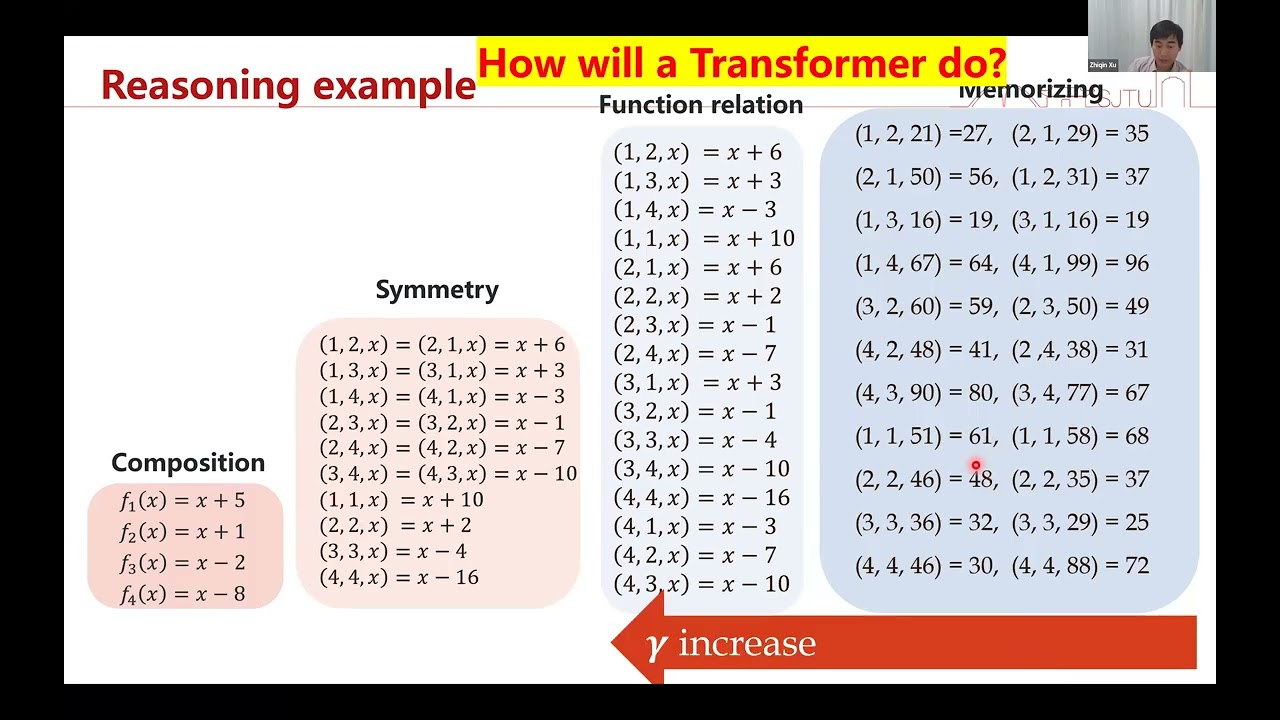
- Toy example with arithmetic equations to illustrate memorization vs reasoning, with four possible approaches.
- Introduction of gamma hyperparameter and its effect on which approach the network uses.
- Visualization of condensation in a 2-layer ReLU network: neurons clustering and reducing effective complexity.
- Application to a diffusion model failure case: adjusting gamma improves reasoning from a memorization regime.
- Discovery that small initialization benefits vanish for LLMs, traced to epsilon in normalization; correction restores gains.
- Attention sink phenomenon and guided attention as a fix, with validation loss improvements for small initialization.
- Conclusion: gamma=1 as a sweet spot, with tradeoff between training dynamics and generalization; recommendation of gamma initialization.
Cited Sources
- An Introduction to Deep Learning (book) — The book summarizes the formulas and experimental phenomena discussed in the talk, and is referenced by the speaker for details.
Contribution & Novelties
The talk introduces a practical and theoretically grounded initialization scheme (gamma scaling) that controls the degree of condensation in neural networks, directly influencing their reasoning ability. This provides a new perspective on why large models generalize and offers a simple hyperparameter adjustment to improve LLM training. The connection between condensation and resonance with ‘compression is intelligence’ is an original framing that could inform future research.
Pour aller plus loin :
- Neural tangent kernel (Wikipedia) — Relevant to the analysis of gradient flow and the evolution of neurons in the infinite-width limit.
- Lottery ticket hypothesis (Wikipedia) — Another mechanism explaining sparse effective subnetworks in overparameterized networks, complementing condensation.
- Weight initialization (Wikipedia) — Background on the impact of initialization on training dynamics and generalization.
122 words
Radar Profile
The radar profile shows high scores in quantitative and technical aspects, reflecting the deep theoretical and experimental depth of the talk. The slightly lower score in global reliability is due to the reliance on the speaker's own work without independent corroboration yet. Overall, the talk is well-rounded with strong technical content and credible foundations, but still an active research area.