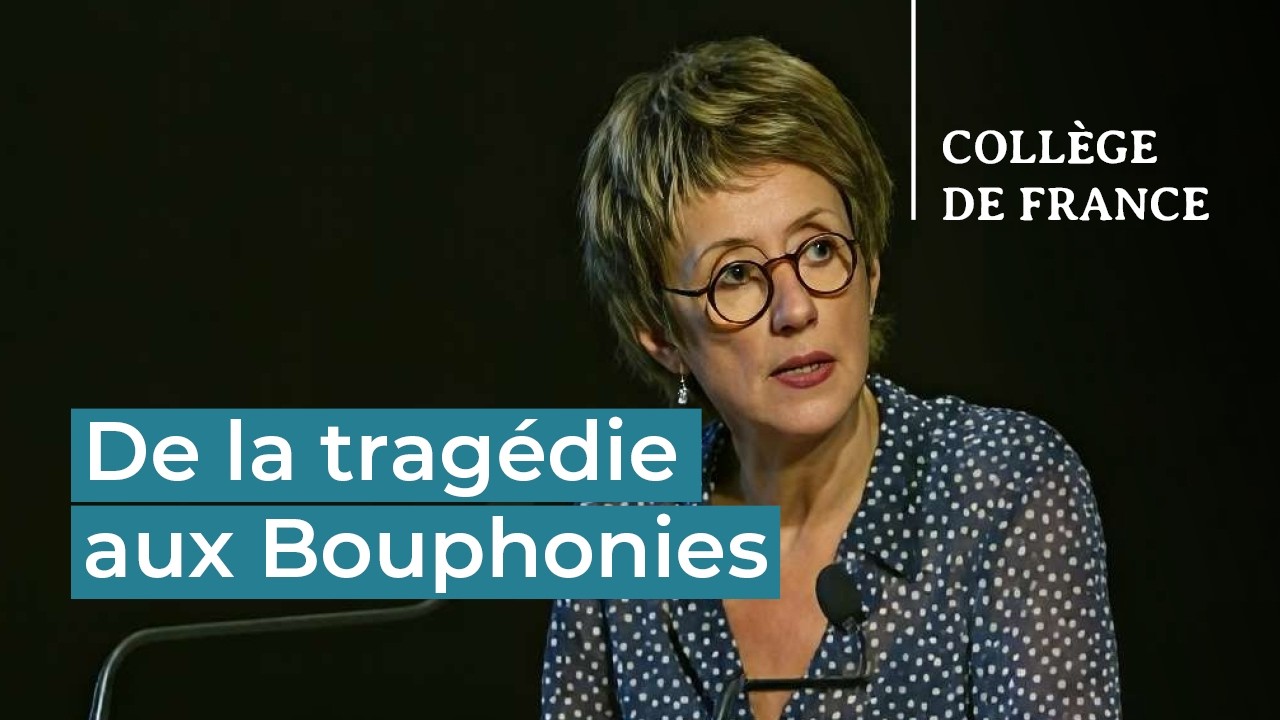
De la tragédie aux Bouphonies : variations sur le sacrifice grec comme meurtre - 2026-2027 (17)
From tragedy to the Bouphonia: variations on Greek sacrifice as murder - 2026-2027 (17)
Keywords
Summary
234 words
Critical Evaluation
Value of the Information & Strength of the Argument
The value of this lecture lies in its meticulous philological analysis of ancient texts and its successful synthesis of philosophical criticism and tragic theatre. The argumentation is exceptionally solid: Pirenne-Delforge skillfully navigates between the normative vocabulary of ritual (thysia) and its subversive or deviant applications in tragedy (anomos, adaitos). She demonstrates a clear progression from the foundational myth (Prometheus) through philosophical condemnation (Theophrastus) to tragic dramatization (Aeschylus, Euripides), thereby constructing a compelling case for a ‘cultural reflexivity’ in Greek society. The lecturer explicitly engages with major historiographical frameworks (Burkert, Girard) but convincingly argues for a historical anthropology over evolutionary psychology, underscoring that the coexistence of ‘violence’ and ‘feast’ interpretations depends on the type of documentary source analyzed. The tight structure and the use of alpha-privative epithets as analytical tools make the reasoning highly persuasive and original.
Scientific Rigor, Source Quality, Title Accuracy
The scientific rigor is exemplary. She bases her analysis on canonical Greek sources (Hesiod, Aeschylus, Euripides) and references crucial fragmentary texts (Theophrastus, Porphyry) with appropriate caveats about their transmission. She accurately situates scholarly debates concerning sacrifice, mentioning the work of Burkert, Girard, and the critique of the evolutionist ‘primordial violence’ school. The sources are cited with context, including specific passages and vocabulary as they appear in the original Greek. The title ‘De la tragédie aux Bouphonies : variations sur le sacrifice grec comme meurtre’ perfectly matches the content, as the lecture moves seamlessly from the tragic stage to the civic ritual, systematically addressing the murderous aspect of sacrifice. The fact that it was presented at the Collège de France adds an institutional layer of reliability.
276 words
Title / Content Match
The title accurately reflects the content, tracing the evolution from tragic representations of sacrifice to the specific civic ritual of the Bouphonia, consistently examining the notion of sacrifice as murder.
Quality & Reliability
9/10
Lecture delivered by a distinguished professor of the Collège de France, member of the Académie des inscriptions et belles-lettres. Rigorous philological and historical methodology grounded in primary sources (Hesiod, Aeschylus, Euripides, Theophrastus) and explicit engagement with secondary scholarship (Burkert, Girard). Institutional credibility is maximal, and the argumentation is logically structured.
Key Moments
Markers derived by PSI from the transcript: the creator did not define chapters.
- Introduction of Vinciane Pirenne-Delforge and the central thesis: Greek culture as both sacrificiant and reflexive.
- Definition of sacrifice as a three-pillar institution: animal killing, carnal consumption, and contact with the divine.
- Analysis of Hesiod's Theogony: Prometheus's division of the ox at Mekone and its role in defining the human condition.
- Philosophical critiques of sacrifice: Heraclitus, Empedocles, and Theophrastus challenging animal killing and the term 'phonos' (murder).
- Historiographical overview of 20th-century debates: Burkert and Girard's 'violence' perspective vs. the 'commensality' school.
- Close reading of Aeschylus' *Agamemnon*: the sacrifice of Iphigenia described with normative terms (thysia) and deviant epithets (anomos, adaitos).
- Transition to Euripides' *Iphigenia at Aulis*: voluntary sacrifice, the substitution with a deer, and the suppression of the feast.
- Synthesis: the tragic blurring between ritual and murder; concluding thoughts on the implications for the ancient Greek perception of the Bouphonia.
Cited Sources
- Colloque de rentrée 2026 : L'animal — page du colloque — Official program page hosting the presentation and recordings of the session titled 'Tuer ou ne pas tuer ?' where this lecture was given.
- Collège de France - Official Website — Institutional domain providing access to all lectures, seminars, and symposia recordings of the Collège de France.
Concurring Sources
- Theogony - Hesiod — Primary source describing the foundational myth of the division of the ox at Mekone, which the lecturer cites as the origin of the sacrificial condition.
- Oresteia - Aeschylus — Trilogy containing 'Agamemnon', whose tragic vocabulary the lecture analyzes to highlight the tension between sacrifice and murder.
- Iphigenia in Aulis - Euripides — Tragedy used by the lecturer to explore voluntary sacrifice and the substitution of an animal victim, illustrating changes in ritual narrative.
Dissenting Sources
- Homo Necans - Walter Burkert — Burkert's theory foregrounds primordial violence and a deep-seated guilt in sacrificial ritual, contrasting sharply with the 'commensality and feast' interpretation which Pirenne-Delforge argues is now dominant and more historically grounded.
External References
Contribution & Novelties
The main contribution of this lecture is its methodological demonstration that the understanding of even a well-studied practice like Greek sacrifice is deeply conditioned by the nature of the selected documentary corpus. By contrasting the tragic, philosophical, and epigraphic/archaeological evidence, Vinciane Pirenne-Delforge convincingly reconciles the seemingly incompatible historiographical camps of ‘violence’ and ‘commensality’. Her focus on the alpha-privative epithets (anomos, adaitos) as diagnostic tools for cultural tension offers a fresh philological pathway for discussing the moral dimension of animal slaughter in antiquity.
Pour aller plus loin :
- Homo Necans: The Anthropology of Ancient Greek Sacrificial Ritual and Myth — Central reference point for the ‘violence’ school, representing the evolutionary interpretation that the lecture critically reassesses.
- Violence and the Sacred - René Girard — Girard’s theory of sacrifice as a mechanism for managing primeval aggression and the scapegoat mechanism, a central theoretical adversary of the ‘commensality’ view.
- Theophrastus - Wikipedia — Key historical figure cited in the lecture whose treatise On Piety argued against animal sacrifice for the gods, providing an explicit ancient critique of ritual killing.
176 words
Radar Profile
The radar profile shows extremely high scores in information quality and technical level, confirming the rigorous academic nature of the presentation. While the quantity of information is also high, the depth and precision of the philological analysis outweigh the sheer factual data, resulting in an excellent, highly specialized scientific contribution.