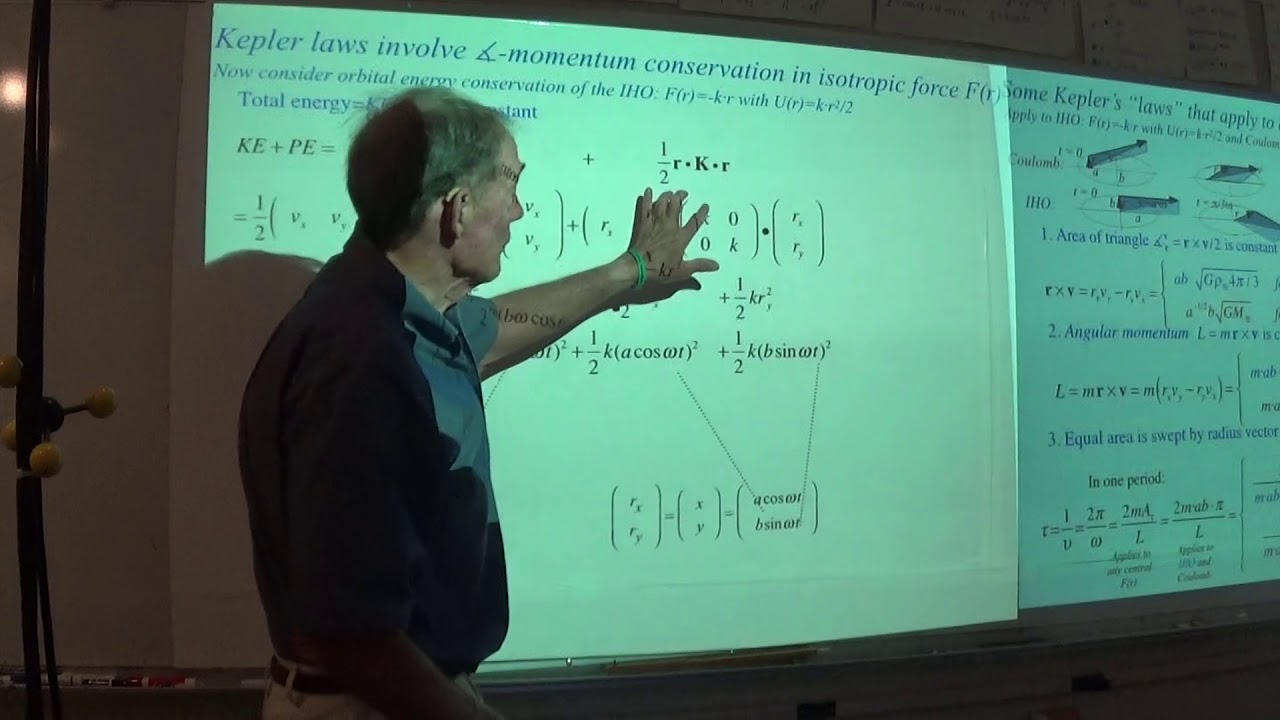
Classical Mechanics with a Bang! (2018 Fall) - Lecture #7 Part2/2
Keywords
Summary
149 words
Critical Evaluation
Value of the Information & Strength of the Argument
The lecture provides valuable insights into the geometric interpretation of classical mechanics, particularly the role of quadratic forms in unifying position and momentum spaces. The argumentation is rigorous, building on mathematical derivations and visualizations. The instructor clearly explains the duality between R and P vectors and the significance of the square root matrix, which is a non-trivial concept. The presentation is well-structured, moving from specific examples (oscillator, Coulomb) to general principles. The value lies in deepening understanding of the mathematical foundations, which is essential for advanced study.
Scientific Rigor, Source Quality, Title Accuracy
The scientific rigor is high, as the lecture is based on a textbook developed by the instructor and is part of a university course. The mathematical derivations are consistent and the geometric interpretations are sound. However, the video does not cite external sources; it relies on the course textbook and prior lectures. The title accurately reflects the content, which is a lecture on classical mechanics. No comments were provided for analysis.
173 words
Title / Content Match
The title accurately reflects the content, which is a lecture on classical mechanics.
Quality & Reliability
8/10
Lecture by a university professor, part of a graduate course, based on a textbook. Content is mathematically rigorous and internally consistent, but no external sources are cited in the video.
Key Moments
Markers derived by PSI from the transcript: the creator did not define chapters.
- Introduction to invariants: area of triangle, angular momentum, area swept.
- Derivation of area and angular momentum for isotropic oscillator and Coulomb orbits.
- Discussion on period independence for isotropic oscillator and dependence on major axis for Coulomb.
- Introduction to quadratic forms and their representation of ellipses.
- Geometric interpretation of matrix transformation from R to P, showing duality.
- Explanation of orthogonality between R and tangent, and P and tangent.
- Zigzag construction and square root matrix as intermediate step.
- Connection to eigenvectors and higher dimensions.
- General quadratic forms at an angle and gradient interpretation.
- Connection to Lagrangian and Hamiltonian mechanics, and quantum mechanics.
Cited Sources
- Course Web site — Course website for the textbook and lectures.
- Lecture #1 slide presentation (pdf) — PDF slides for the first lecture, likely containing foundational material.
Concurring Sources
- Course Web site — Course website for the textbook and lectures.
Contribution & Novelties
This lecture provides a unique geometric perspective on classical mechanics, emphasizing the role of quadratic forms in unifying position and momentum spaces. The explicit construction of the square root matrix as a bridge between Lagrangian and Hamiltonian formulations is a novel pedagogical approach. The lecture also highlights the deep connection between classical and quantum mechanics through geometry.
Pour aller plus loin :
- Quadratic form — Wikipedia article on quadratic forms, foundational to the lecture.
- Hamiltonian mechanics — Wikipedia article on Hamiltonian mechanics, relevant to the Lagrangian-Hamiltonian connection.
- Ellipse — Wikipedia article on ellipses, central to the geometric interpretation.
98 words
Radar Profile
The radar profile shows high scores in technical level and information quality, indicating a mathematically rigorous and well-structured lecture. The moderate scores in quantity and reliability reflect the focused scope and lack of external citations.