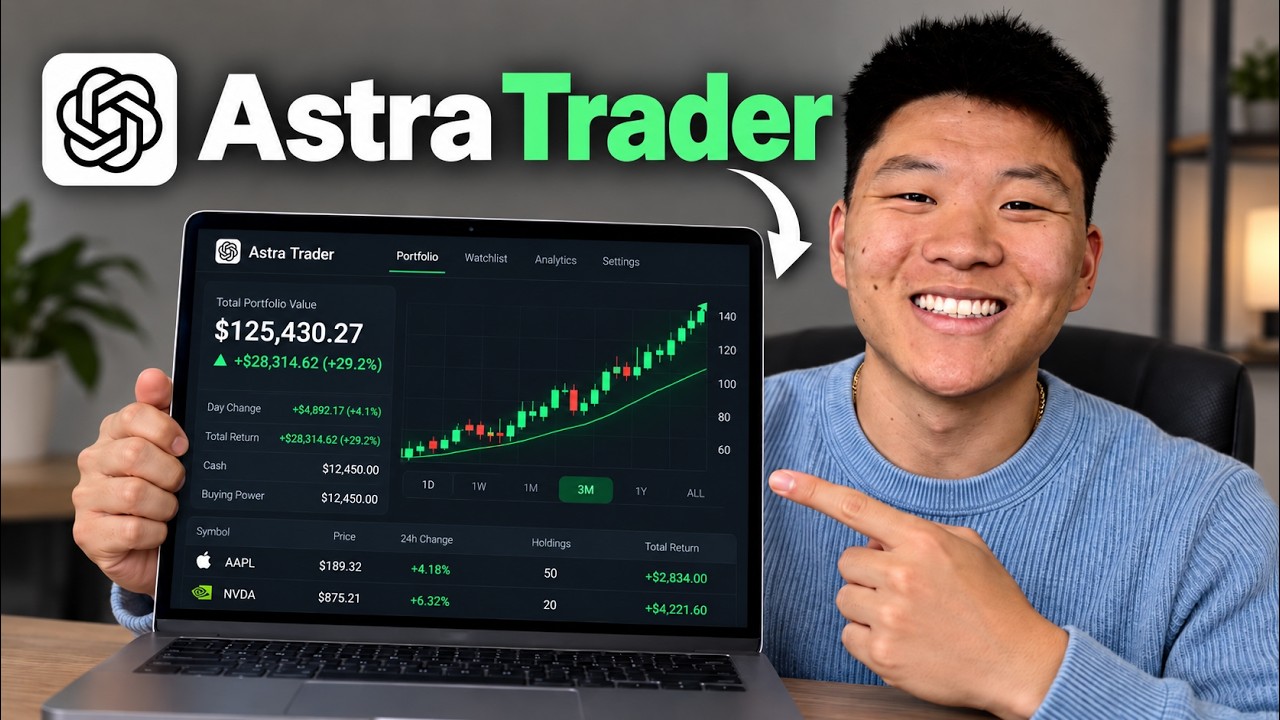
I Turned GPT-6 Astra Into a 24/7 Stock Trader (tutorial)
Keywords
Summary
147 words
Critical Evaluation
Value of the Information & Strength of the Argument
The video provides a clear, actionable tutorial for setting up an AI trading agent, which is valuable for those interested in AI automation in finance. The argumentation is based on the creator’s personal experience and the capabilities of GPT-6 Astra, but it lacks empirical evidence or comparative analysis. The strategy is presented as a template, but the reasoning behind specific choices (e.g., six wakeups, timing) is not deeply justified. The creator does emphasize risk management by recommending paper trading, which adds credibility. However, the overall argumentation is more persuasive than scientific, relying on the novelty of the AI model rather than robust data.
Scientific Rigor, Source Quality, Title Accuracy
The video is a tutorial with a practical focus, and the title accurately reflects its content. The creator mentions using Alpaca for trading and Codex for automation, but does not provide external sources or references to support claims about AI performance or trading strategies. The description includes links to his own resources and tools, which are promotional rather than scientific. The video includes a disclaimer that it is not financial advice, which is responsible. The content is not rigorously sourced, and the creator’s claims about the AI’s capabilities are anecdotal. The title is appropriate, and the content matches it well.
218 words
Title / Content Match
The title accurately reflects the content: a tutorial on setting up GPT-6 Astra as a stock trading agent.
Quality & Reliability
6/10
The video is a practical tutorial with clear steps, but it relies on anecdotal evidence and promotional content. The creator's claims about AI performance are not backed by rigorous data, and the financial advice is disclaimed. The tutorial is reproducible but lacks scientific depth.
Chapters
Cited Sources
- AI Automation Society - Agency Playbook — Promotional link for the creator's agency playbook.
- Glaido - Voice to Text — Tool mentioned as a resource for the tutorial.
- Hostinger VPS — Recommended hosting service for running AI agents.
- Nate Herk on LinkedIn — Creator's professional profile.
- AI Automation Society - Free Resources — Free resource guide mentioned in the video.
Concurring Sources
- Alpaca Markets — Brokerage platform used for trading, mentioned in the video.
Dissenting Sources
- Academic studies on AI trading performance — No specific studies are cited, but the video's claims about AI outperforming the S&P are anecdotal and not supported by peer-reviewed research.
Contribution & Novelties
The video demonstrates a practical application of AI in automated trading, showcasing a workflow that integrates multiple tools (Alpaca, Codex, ClickUp) to create a 24/7 trading agent. The novelty lies in the detailed setup process and the emphasis on continuity through progress logs, which is a common challenge in AI agent automation. The creator also highlights the importance of paper trading before risking real money, which is a responsible approach.
Pour aller plus loin :
- Algorithmic trading — Overview of algorithmic trading concepts.
- API — Explanation of APIs, relevant to connecting Alpaca.
- Reinforcement learning — Potential approach for AI trading agents to learn from market data.
106 words
Radar Profile
The radar profile shows moderate scores across all dimensions, with a slight strength in information quantity and technical level, but weaknesses in information quality and reliability. This reflects a tutorial that is informative but lacks scientific rigor and relies on anecdotal evidence.