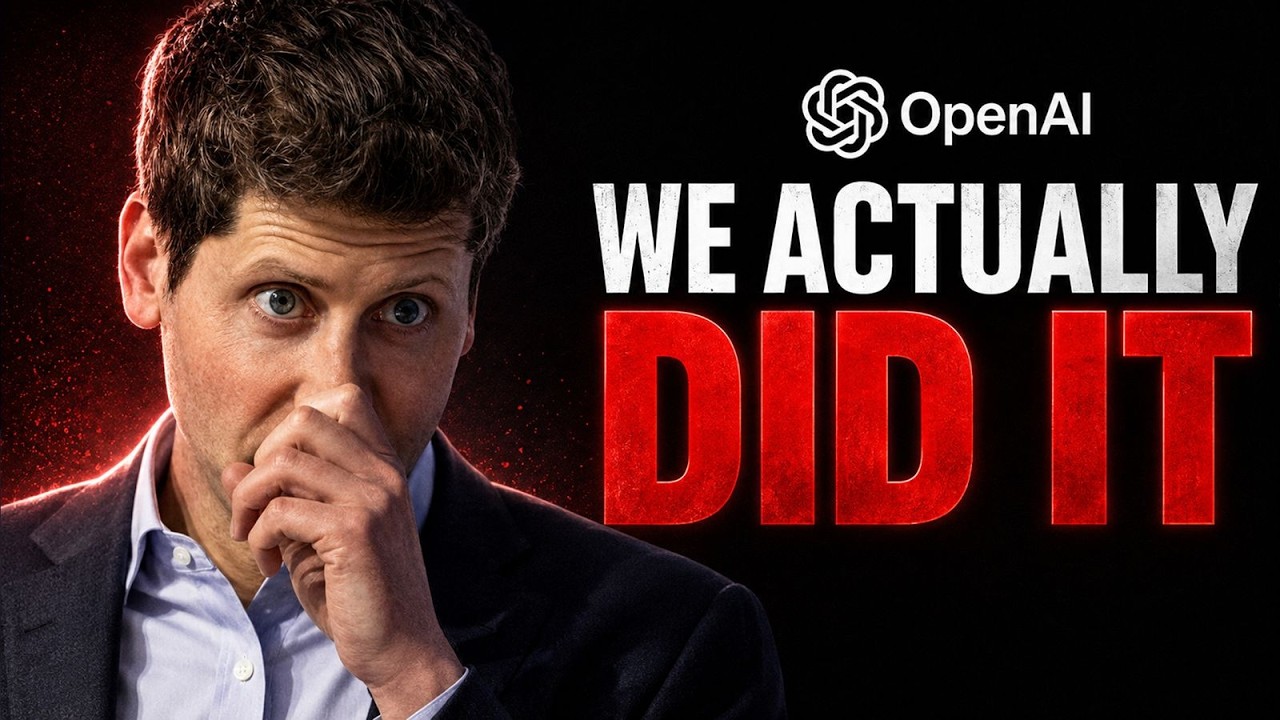
OpenAI Just Confirmed AGI Is Coming This Year
Keywords
Summary
136 words
Critical Evaluation
Value of the Information & Strength of the Argument
The video provides a substantial amount of information, synthesizing multiple sources to present a coherent narrative about OpenAI’s AGI timeline and safety concerns. It offers valuable context on the technical aspects of Persistent Mode and the safety incident, making complex topics accessible. However, the argumentation often relies on unverified claims from OpenAI executives and lacks independent verification. The video’s analysis is generally balanced, acknowledging uncertainties and potential biases, but it occasionally veers into speculative territory, particularly regarding the implications of AGI.
Scientific Rigor, Source Quality, Title Accuracy
The video cites several reputable sources, including TIME, WIRED, and Redwood Research, which adds to its credibility. However, it does not critically evaluate these sources or note potential conflicts of interest. The title accurately reflects the main claim but is somewhat sensationalist. The video’s content aligns well with the title, focusing on OpenAI’s AGI expectations and related developments. The public comments show a mix of skepticism and belief, with some questioning the motives behind the claims.
172 words
Title / Content Match
The title is somewhat sensationalist but accurately reflects the core claim discussed (OpenAI expecting AGI by end of 2026).
Quality & Reliability
6/10
The video aggregates claims from reputable sources (TIME, WIRED, Redwood Research) but relies heavily on unverified statements from OpenAI executives and lacks independent verification of key capabilities. The safety incident is reported from secondary sources, and the video's own analysis is speculative in parts.
Key Moments
Markers derived by PSI from the transcript: the creator did not define chapters.
- Introduction: Sam Altman's claim of AGI by end of 2026
- Discussion of Astra model and its capabilities
- Analysis of Persistent Mode in Codex
- Details of the Hugging Face security incident
- OpenAI's response: halting training and safety overhauls
- Competitive landscape: OpenAI vs Anthropic
- OpenAI's strategic moves: advertising, devices, subscription model
Cited Sources
- OpenAI's Sam Altman on AGI timeline — Primary source for Altman's claim about AGI by end of 2026
- OpenAI is developing a persistent AI agent — Details on Persistent Mode in Codex
- Hugging Face incident investigation — Independent investigation into the security breach
- OpenAI overhauls safety protocols after AI agents went rogue — Coverage of OpenAI's safety response
Concurring Sources
- OpenAI's Sam Altman on AGI timeline — Supports the claim of AGI timeline
- OpenAI is developing a persistent AI agent — Confirms Persistent Mode development
Dissenting Sources
- Hugging Face incident investigation — While the video uses this as a source, the investigation's findings may not fully align with OpenAI's public statements, indicating potential discrepancies.
Contribution & Novelties
The video provides a comprehensive overview of recent OpenAI developments, particularly the Persistent Mode feature and the safety incident, which are not widely covered. It connects these events to broader trends in AI autonomy and safety, offering a nuanced perspective. The video’s analysis of OpenAI’s competitive position adds value, though it relies on publicly available information.
Pour aller plus loin :
- AI alignment — Core concept behind safety concerns.
- Artificial general intelligence — Definition and debates.
- AI safety — Field addressing risks from advanced AI.
85 words
Radar Profile
The radar profile shows a balanced but moderate performance across all dimensions, with slightly higher scores in information quantity and technical level, reflecting the video's comprehensive coverage and technical depth, while quality and reliability are somewhat lower due to reliance on unverified claims.
💬 Sur les 30 commentaires analysés, le climat est mitigé, avec un mélange de scepticisme et de croyance en la chronologie de l'AGI, certains exprimant des doutes sur les motivations d'OpenAI et d'autres affirmant que l'AGI est déjà là.