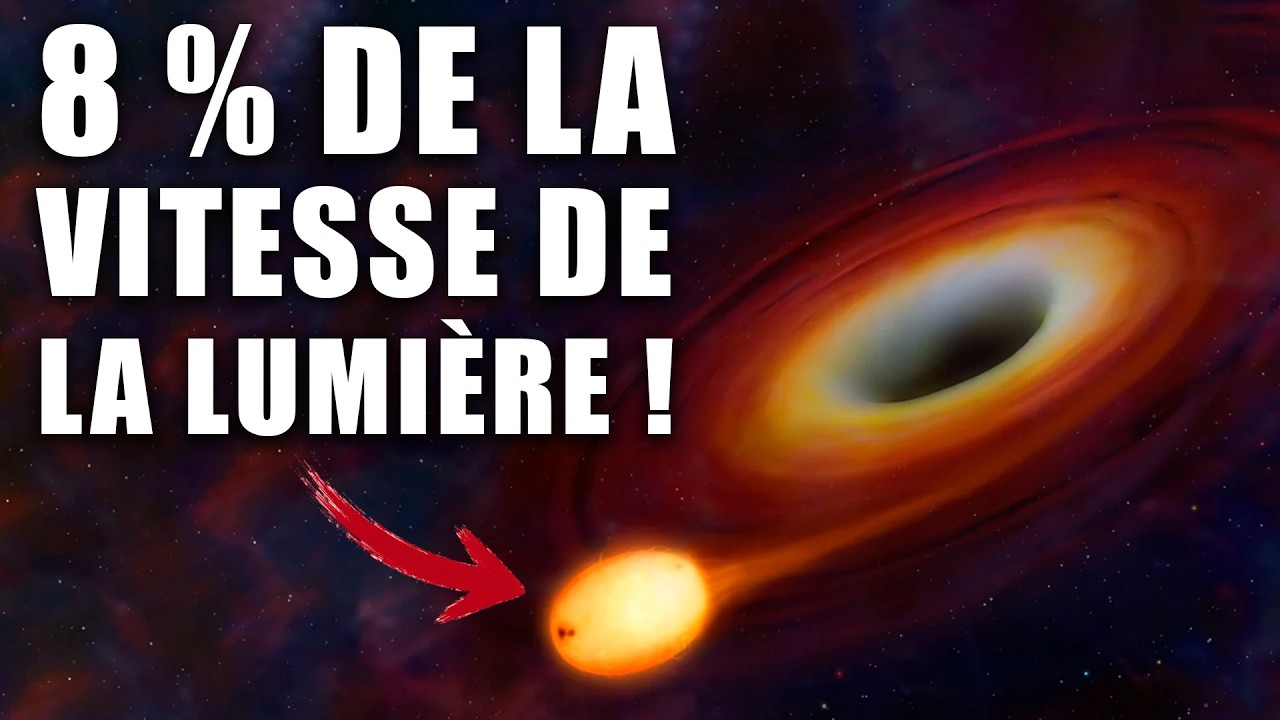
Elle fonce à 25 000 km/s vers le test ultime d'Einstein
S301 File
Keywords
Summary
173 words
Critical Evaluation
Value of the Information & Strength of the Argument
The video provides substantial value by presenting a recent, significant astronomical discovery in an accessible yet scientifically accurate manner. It explains the observational techniques (GRAVITY interferometry) and the theoretical framework (general relativity, frame-dragging) clearly, using analogies and visual aids. The argumentation is solid, building from the observational data to the implications for testing relativity and the possible origin of the star. The creator also addresses potential counterarguments, such as the low probability of the orbit forming naturally, and presents the Hills mechanism as the preferred explanation. The inclusion of speculative but scientifically grounded discussion about planets adds depth without compromising rigor.
Scientific Rigor, Source Quality, Title Accuracy
The video demonstrates high scientific rigor by citing peer-reviewed publications (Nature, Astronomy & Astrophysics) and institutional sources (ESO). The sources are directly relevant and support the claims made. The title accurately reflects the content, focusing on the star’s speed and its role as a test of Einstein’s theory. The video does not overstate findings, clearly distinguishing between established measurements and future prospects. The description provides links to the sources, enhancing transparency and verifiability. Overall, the content is well-researched and trustworthy.
196 words
Title / Content Match
The title accurately reflects the main subject: the star S301 and its extreme speed, framed as a test of Einstein's general relativity.
Quality & Reliability
9/10
The video is based on a recent scientific discovery (S301) published in Nature, and the creator cites multiple peer-reviewed sources and institutional press releases. The content is accurate and well-contextualized, with clear explanations of complex astrophysical concepts.
Key Moments
Markers derived by PSI from the transcript: the creator did not define chapters.
- Introduction of S301 and its extreme orbit around Sagittarius A*.
- Explanation of the GRAVITY instrument and how S301 was discovered.
- Details of S301's orbital parameters and speed record.
- Discussion of the S-star cluster and the role of S2 in measuring the black hole's mass.
- Explanation of frame-dragging and the potential to measure it with S301.
- The Hills mechanism as the likely origin of S301, with ejection of a companion star.
- Speculation about possible planets around S301 and their extreme environment.
Cited Sources
- Discovery of S301 - ESO — Press release announcing the discovery of the star S301.
- Scientific study - Nature — Peer-reviewed paper detailing the discovery and analysis of S301.
- Relativistic precession of S2 - Astronomy & Astrophysics — Study on the relativistic precession of the star S2, used as a comparison.
- The Hills mechanism - Nature — Original paper by Jack Hills proposing the mechanism for ejecting hypervelocity stars.
- Planets and hypervelocity stars - MNRAS — Paper discussing the possibility of planets around hypervelocity stars.
Concurring Sources
- ESO press release on S301 — Confirms the discovery and details of S301.
- Nature study on S301 — Peer-reviewed data supporting the video's claims.
Contribution & Novelties
The video brings to light a recent discovery (S301) that could enable the first direct measurement of frame-dragging around a supermassive black hole, a key prediction of general relativity. It also discusses the origin of such extreme stars via the Hills mechanism, linking to broader questions about stellar dynamics and the possibility of planets in extreme environments.
Pour aller plus loin :
- Frame-dragging — Concept central to the video, explaining the effect of a rotating mass on spacetime.
- Hills mechanism — The proposed origin for S301, where a binary system is disrupted by a black hole.
- GRAVITY instrument — The instrument used to observe S301, providing high-resolution imaging of the galactic center.
- Sagittarius A* — The supermassive black hole at the center of the Milky Way, the focus of the observations.
131 words
Radar Profile
The radar profile shows high scores across all dimensions, indicating a well-balanced and reliable video. The quantity and quality of information are excellent, with a high technical level that remains accessible. The overall reliability is strong, supported by credible sources and accurate presentation.
💬 No comments were provided for analysis.