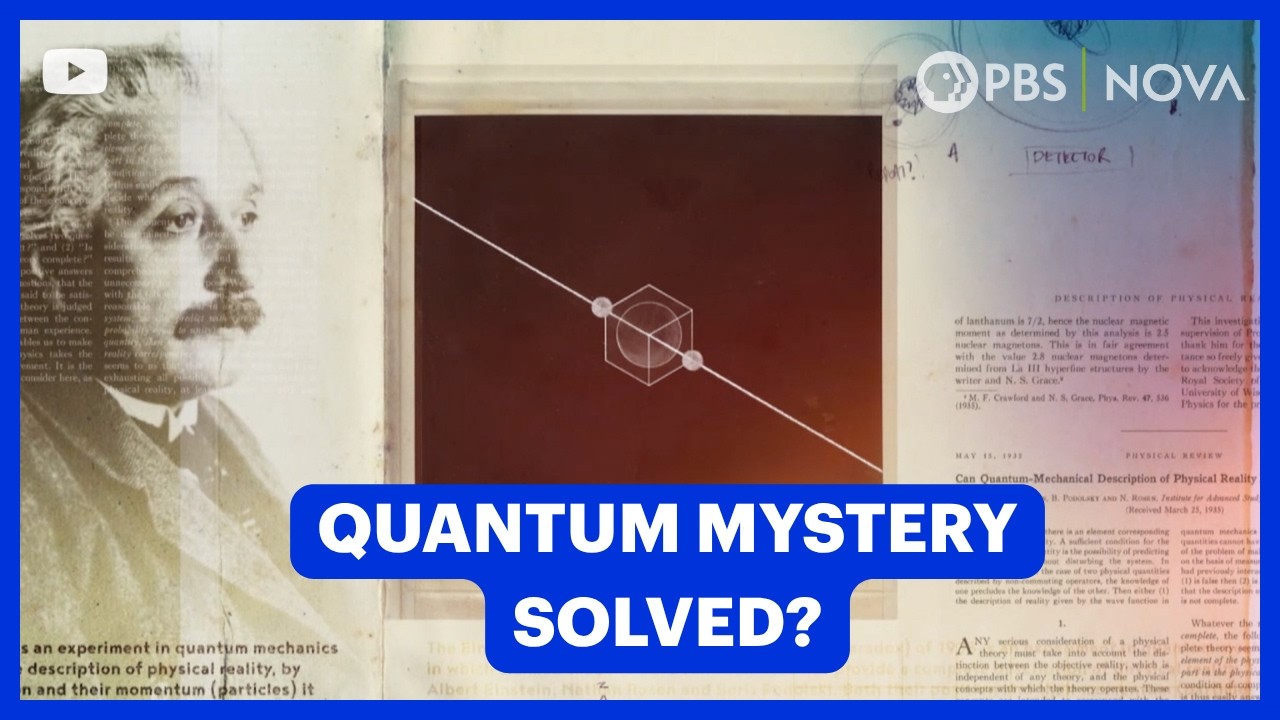
Space and Time Might Be an Illusion | NOVA | PBS
Keywords
Summary
143 words
Critical Evaluation
Value of the Information & Strength of the Argument
The video provides a compelling and accessible explanation of a complex quantum physics experiment. It effectively uses the historical context of the Einstein-Bohr debate to frame the significance of the cosmic Bell test. The argumentation is solid, clearly explaining the loophole in previous Bell tests and how the use of quasars addresses it. The inclusion of interviews with the researchers adds credibility and a human element. The value of the information is high, as it presents a recent and significant scientific result in a way that is understandable to a general audience.
Scientific Rigor, Source Quality, Title Accuracy
The video is produced by NOVA PBS, a trusted source for science documentaries. The content is based on a real experiment published in Physical Review Letters (Handsteiner et al., 2017). The description provides links to the full documentary and NOVA’s newsletter, but not directly to the scientific paper. The title accurately reflects the content, which is a test of quantum entanglement’s reality. The video maintains scientific rigor by explaining the experimental setup and the significance of the results without overstating the conclusions.
189 words
Title / Content Match
The title accurately reflects the content, which investigates the reality of quantum entanglement through a cosmic Bell test experiment.
Quality & Reliability
8/10
The video is produced by NOVA PBS, a reputable science documentary series, and features interviews with leading physicists involved in the cosmic Bell test experiment. The content is based on a peer-reviewed experiment published in Physical Review Letters, and the explanation of quantum entanglement and Bell's theorem is accurate and well-illustrated. However, the video is a condensed version of a longer documentary, and some simplifications are made for a general audience.
Key Moments
Markers derived by PSI from the transcript: the creator did not define chapters.
- Introduction to the question of whether quantum entanglement is real, referencing the Clauser-Freedman Bell test.
- Explanation of the 'loophole' in Bell tests: the possibility of a common cause influencing the random settings.
- Introduction to the cosmic Bell test experiment in the Canary Islands, using quasars to control the settings.
- The team aligns telescopes on two distant quasars and begins the experiment.
- Data collection and initial results showing correlations consistent with quantum mechanics.
- Analysis in Vienna confirms the results, closing the loophole and supporting entanglement.
- Discussion of the profound implications: entanglement implies non-locality or observer-dependent reality.
- Exploration of the holographic principle and the idea that space itself emerges from entanglement.
Cited Sources
- Einstein's Quantum Riddle (full documentary) — The video is an excerpt from this full documentary, which provides more context and detail.
- NOVA Newsletter — Mentioned in the description for staying up to date on NOVA content.
Concurring Sources
- Bell's theorem — The video's explanation of Bell tests aligns with the standard description of Bell's theorem.
- Quantum entanglement — The video's description of entanglement as a real phenomenon is consistent with the scientific consensus.
Contribution & Novelties
The video’s original contribution is its clear and engaging presentation of the cosmic Bell test experiment, which is a landmark achievement in closing the ‘freedom of choice’ loophole. It effectively communicates the significance of using quasars to ensure randomness in the experiment, and it connects the results to broader theoretical ideas like the holographic principle. The video also provides a historical perspective, linking the modern experiment to the original Einstein-Bohr debate.
Pour aller plus loin :
- Bell’s theorem — Provides the mathematical framework for testing quantum entanglement.
- Quantum entanglement — Overview of the phenomenon and its implications.
- Holographic principle — The idea that space emerges from quantum information, as discussed in the video.
- Handsteiner et al., 2017, Physical Review Letters — The original scientific paper describing the cosmic Bell test experiment.
131 words
Radar Profile
The radar profile shows high scores in information quality and technical level, reflecting the video's strong scientific content and clear explanations. The quantity of information is also high, but the overall score is slightly lower due to the video's brevity and focus on a single experiment. The reliability score is high, consistent with the trusted source.