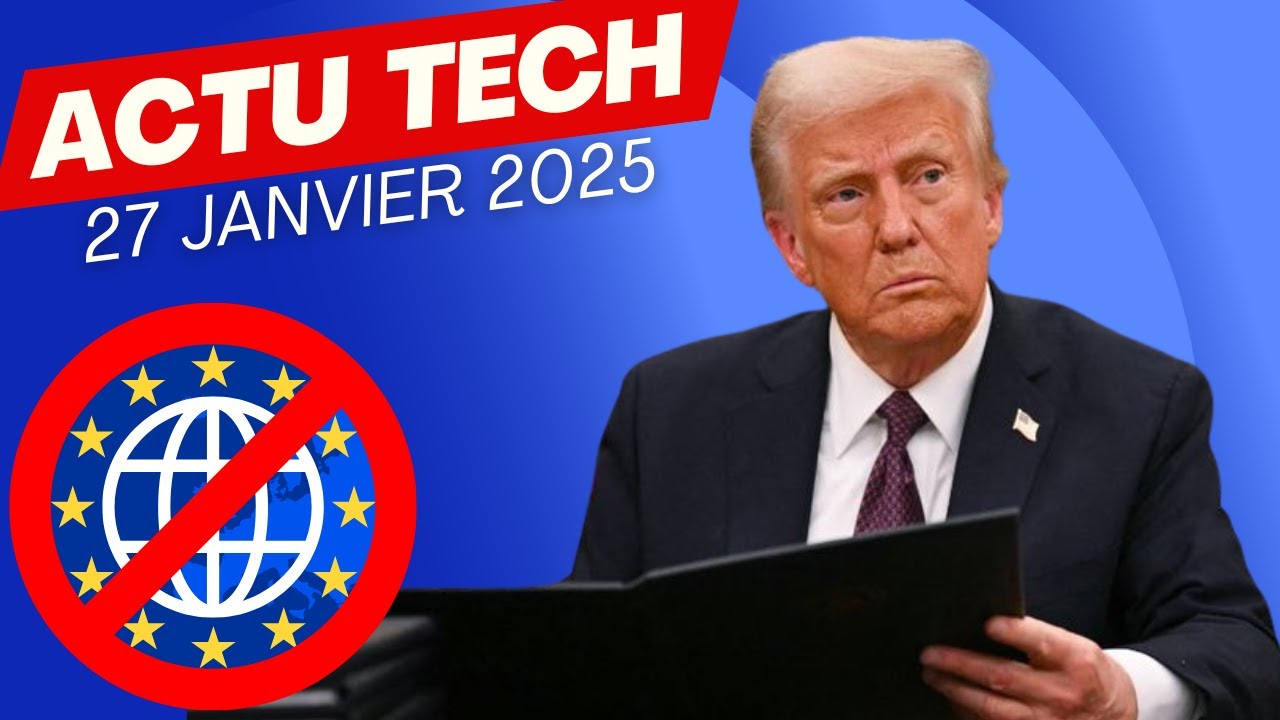
Trump va tuer le web de l'Europe ! L'heure des choix ! Et toutes les actus Tech du jour.
Trump will kill Europe's web! Time to decide! And all the tech news of the day.
Keywords
Summary
150 words
Critical Evaluation
Value of the Information & Strength of the Argument
The video provides a valuable overview of current tech policy issues, particularly the potential impact of US political decisions on European digital sovereignty. The host’s argumentation is structured and clear, explaining complex concepts like PCLOB and TDPF in accessible terms. However, the reasoning often relies on hypothetical scenarios and personal opinions rather than concrete evidence. The discussion of the Hult study is presented without critical examination of its methodology or representativeness, and the 37% figure is used to support a strong claim about AI replacing young workers. The host’s stance on Lucie is balanced, acknowledging both its potential and its current flaws, but the overall argumentation tends to be persuasive rather than purely informative.
Scientific Rigor, Source Quality, Title Accuracy
The video demonstrates moderate scientific rigor. The host mentions specific institutions and studies (e.g., Hult, PCLOB, TDPF) but does not provide direct citations or links within the video. The description includes only a link to the host’s website, which may contain additional resources. The title accurately reflects the content, though it uses sensationalist language. The video is a news review, so it relies on secondary sources, but the lack of explicit sourcing for key claims reduces its reliability. The host’s commentary is opinionated, which is acceptable for this format, but it should be clearly distinguished from factual reporting.
227 words
Title / Content Match
The title accurately reflects the main topic (Trump's potential impact on European web) and the general tech news format, though it is sensationalist.
Quality & Reliability
6/10
The video presents a mix of factual claims and personal opinions, with limited direct sourcing. The host provides context for some claims (e.g., the PCLOB and TDPF) but often relies on interpretation. The tone is engaging but occasionally alarmist, and the lack of citations for key statistics (e.g., the 37% figure) reduces reliability.
Chapters
Cited Sources
- Renaud Dékode website — Mentioned as a place for discussion and additional resources.
Concurring Sources
- Data Privacy Framework — Official EU-US data transfer framework, relevant to the discussion.
Contribution & Novelties
The video synthesizes recent tech news with a focus on European digital sovereignty, offering a perspective on the potential consequences of US policy changes. It highlights the fragility of the current transatlantic data framework and the urgent need for European alternatives. The discussion of the Hult study adds a concrete data point to the AI and employment debate.
Pour aller plus loin :
- Transatlantic Data Privacy Framework (TDPF) — Background on the EU-US data transfer agreement.
- Privacy and Civil Liberties Oversight Board (PCLOB) — Official site of the US oversight board.
- Hult International Business School — Institution that conducted the cited study on AI and employment.
- EAST fusion reactor — Information on the Chinese fusion experiment.
- Lucie AI — Official site of the French open-source AI initiative.
127 words
Radar Profile
The radar profile shows a balanced but moderate performance across all dimensions, with slightly higher scores in information quantity and quality, and lower in technical depth and reliability. This indicates a video that is informative and accessible but lacks deep technical analysis and robust sourcing.
💬 Sur les 30 commentaires analysés, le climat est globalement positif et engagé, avec des discussions sur les implications politiques et technologiques, et quelques critiques sur la longueur des vidéos.