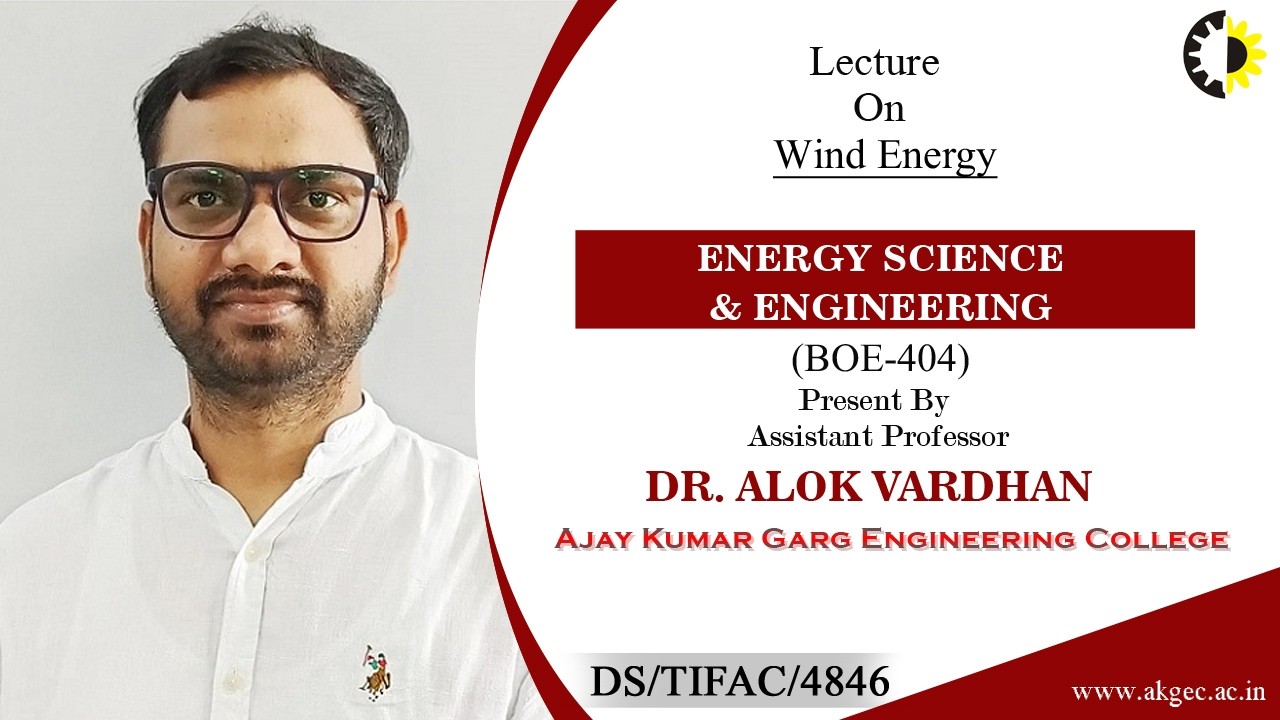
WIND ENERGY | ENERGY SCIENCE & ENGINEERING | LECTURE 03 BY DR. ALOK VARDHAN | AKGEC
Keywords
Summary
170 words
Critical Evaluation
Value of the Information & Strength of the Argument
The lecture provides a solid foundational overview of wind energy, covering key concepts such as the origin of wind, the momentum theory, and turbine classifications. The argumentation is logical and progresses from basic principles to practical applications. However, the depth is limited; for instance, the momentum theory is introduced but not derived in detail, and efficiency figures are presented without rigorous justification. The discussion of advantages and disadvantages is balanced, but the environmental impact section is brief. The lecture is valuable for beginners but lacks critical analysis and quantitative rigor.
Scientific Rigor, Source Quality, Title Accuracy
The lecture is scientifically accurate in its general principles, but it does not cite specific sources or provide references for the data presented, such as India’s wind energy ranking or capacity figures. The content aligns with standard engineering textbooks, but the lack of citations reduces its scholarly rigor. The title accurately describes the content, and the lecture is well-structured for an educational setting. No comments were provided to analyze public reception.
176 words
Title / Content Match
The title accurately reflects the content, which is a lecture on wind energy as part of an Energy Science & Engineering course.
Quality & Reliability
6/10
The lecture is a structured educational presentation covering fundamental concepts of wind energy, including sources, power generation, turbine types, advantages, limitations, and site selection. The content is generally accurate and aligns with standard engineering knowledge, but it lacks depth in quantitative analysis and does not cite specific sources or recent data. The presentation is clear but contains some inaccuracies (e.g., efficiency ranges, capacity figures) and is based on a single lecturer's perspective without external validation.
Key Moments
Markers derived by PSI from the transcript: the creator did not define chapters.
- Introduction and overview of topics to be covered
- Explanation of wind as an indirect form of solar energy and local winds
- Discussion of planetary winds and global circulation
- Introduction to momentum theory and wind power equation
- Classification of wind turbines: HAWT and VAWT
- Detailed description of HAWT subcategories and their applications
- Description of VAWT types: Savonius and Darrieus rotors
- Advantages and limitations of wind energy
- Environmental impacts and site selection criteria
- Status of wind energy in India and conclusion
Cited Sources
- AKGEC Official Website — Institution providing the lecture
- Energy Science & Engineering Playlist — Playlist containing this lecture and related content
Concurring Sources
- Wind power — General information on wind energy aligns with the lecture's content.
- Betz's law — Theoretical limit of wind turbine efficiency, consistent with the momentum theory.
Dissenting Sources
- Global Wind Energy Council — Current global wind energy statistics may differ from the lecture's data, as the lecture does not specify the year of its information.
Contribution & Novelties
The lecture provides a structured educational overview of wind energy, suitable for undergraduate engineering students. Its originality lies in its comprehensive coverage of turbine types and site selection criteria, though it does not introduce novel research or advanced analysis.
Pour aller plus loin :
- Wind power — Provides a broader overview of wind energy, including global statistics and technological advancements.
- Betz’s law — Explains the theoretical maximum efficiency of wind turbines, complementing the momentum theory discussion.
- Darrieus wind turbine — Detailed information on the Darrieus rotor, a type of VAWT mentioned in the lecture.
- Savonius wind turbine — Further details on the Savonius rotor, another VAWT type.
- Wind energy in India — Provides up-to-date information on India’s wind energy capacity and ranking.
122 words
Radar Profile
The radar profile shows balanced scores across all dimensions, with slightly higher scores in quantity of information and technical level, reflecting the lecture's comprehensive but introductory nature. The quality and reliability scores are moderate, indicating accurate but not deeply sourced content.