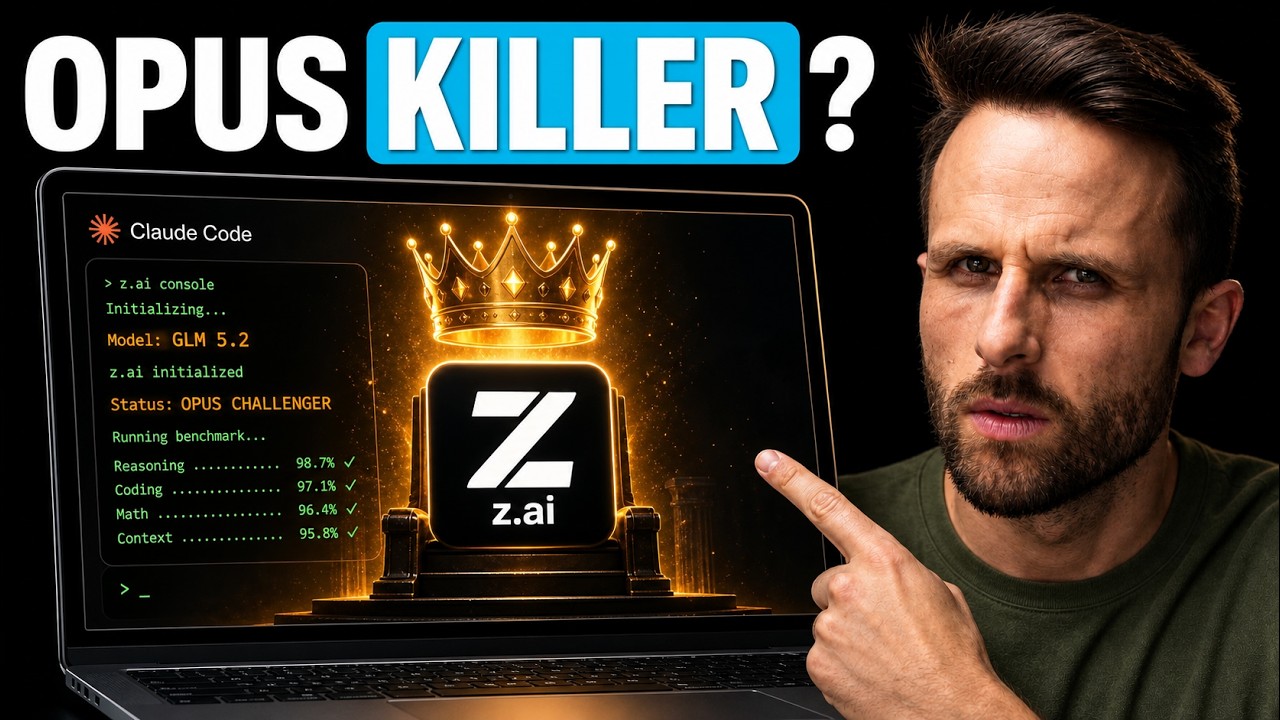
Is GLM 5.2 ACTUALLY Better Than Opus 4.8? (Full Breakdown)
Keywords
Summary
144 words
Critical Evaluation
Value of the Information & Strength of the Argument
The video provides valuable practical insights into the performance and cost of GLM 5.2 versus Opus 4.8. The creator demonstrates a hands-on methodology, using a custom benchmark (SimmonsBench) with real-world tasks, which adds authenticity. The argumentation is based on direct observation and personal judgment, which is transparent but subjective. The cost analysis is concrete and useful for practitioners. However, the lack of rigorous statistical validation and the proprietary nature of the benchmark limit the generalizability of the conclusions.
Scientific Rigor, Source Quality, Title Accuracy
The video references OpenRouter as the platform for accessing GLM 5.2 and provides a GitHub repository for the agent fanout skill. The creator mentions SimmonsBench but does not provide a public link to the benchmark itself, only to the agent fanout skill. The title accurately reflects the content. The evaluation is based on visual inspection and personal preference, which is not a rigorous scientific method. The creator acknowledges the subjectivity of knowledge work evaluation. No external sources are cited beyond the tools used.
176 words
Title / Content Match
The title accurately reflects the content: a head-to-head comparison of GLM 5.2 and Opus 4.8 across coding and knowledge work tasks.
Quality & Reliability
6/10
The video presents a hands-on comparative evaluation of two AI models using a custom benchmark (SimmonsBench). The methodology is transparent in terms of tasks and cost tracking, but the benchmark is proprietary and not peer-reviewed, and the evaluation is subjective (visual inspection, personal preference). The creator acknowledges limitations in prompt design for knowledge work. Overall, the information is useful but not rigorously validated.
Chapters
Cited Sources
- SimmonsBench Agent Fanout — GitHub repository with the skill for fanning out agents, used for the builds.
- OpenRouter API — API endpoint used to run GLM 5.2 via OpenRouter.
- AI Bootcamp — Promotional link for the creator's AI bootcamp.
- AI for Mortals Newsletter — Newsletter subscription link.
Concurring Sources
- OpenRouter — Used as the platform to run GLM 5.2, consistent with the video's methodology.
Contribution & Novelties
The video offers a practical, hands-on comparison of a specific open-source model (GLM 5.2) against a frontier model (Opus 4.8), focusing on real-world coding and knowledge work tasks. It introduces SimmonsBench, a custom benchmark, and provides cost analysis. The novelty lies in the direct application and cost breakdown, which is valuable for practitioners considering model adoption.
Pour aller plus loin :
- OpenRouter — Platform for accessing multiple AI models, central to the video’s setup.
- Claude Code — Anthropic’s CLI tool used for running the models.
- GLM-5.2 on Hugging Face — Model card for GLM 5.2, providing technical details.
98 words
Radar Profile
The radar profile shows high scores in information quantity and technical level, indicating a detailed and technical presentation. However, information quality and reliability are moderate, reflecting the subjective nature of the evaluation and lack of rigorous methodology.