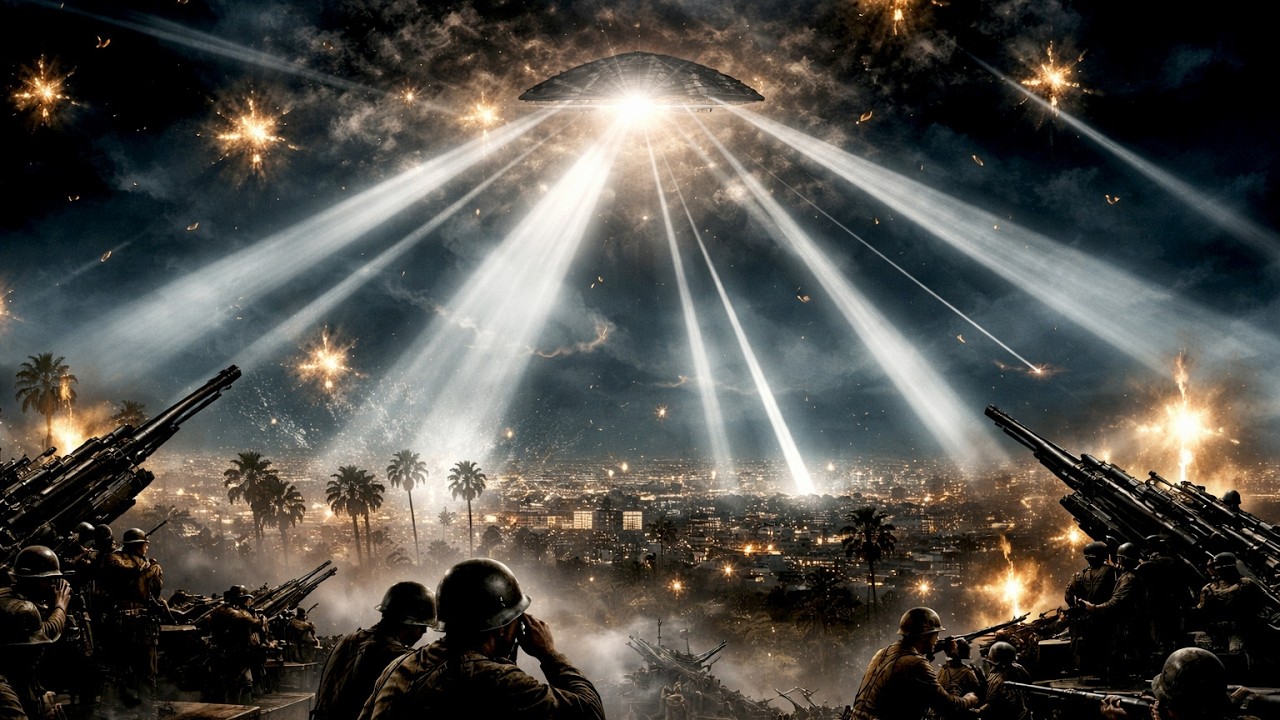
🪐L'OVNI le plus marquant de l'Histoire : la bataille de Los Angeles — Note de synthèse
Note de synthèse · Post Singularity Institute
🪐L'OVNI le plus marquant de l'Histoire : la bataille de Los Angeles
par AstronoGeek
🎙️ AstronoGeek👥 1.1M📅 March 20, 2026⏱ 33 min👁 246K🔬 History & Archaeology
Keywords
Battle of Los AngelesUFO1942World War IImilitary history
Summary
The video recounts the Battle of Los Angeles, a famous UFO incident from February 24-25, 1942, during World War II. It sets the historical context of Japanese attacks on the US West Coast after Pearl Harbor, leading to heightened military alert. On the night in question, radar detected an unidentified object approaching Los Angeles. Despite a blackout and intense anti-aircraft fire (over 1,400 shells), no enemy aircraft were shot down or crashed. Eyewitnesses reported a large, slow-moving, glowing object in the sky, which seemed impervious to the barrage. The military initially claimed it was a false alarm, but later explanations ranged from weather balloons to Japanese planes. The video argues that the object was likely not a conventional aircraft, given the lack of debris, and suggests it remains an unexplained UFO case. The host maintains a skeptical tone, noting that many UFO cases turn out to be hoaxes, but presents this as a potentially genuine anomaly.
Critical Evaluation
The video provides a compelling narrative of the Battle of Los Angeles, a well-known historical event often cited in UFO lore. The host, AstronoGeek, adopts a skeptical stance, acknowledging that many UFO cases are debunked but suggesting this one might be different. The historical context is accurately presented: the attack on Pearl Harbor, the subsequent fear of Japanese raids, and the actual shelling of Santa Barbara by a Japanese submarine. The timeline of events is detailed, from the initial radar contact at 190 km to the cessation of fire around 4 AM. However, the video lacks rigorous sourcing. No primary documents, such as military reports or newspaper articles from the time, are cited. The only link in the description is to a music site (incompetech.com), which is irrelevant to the content. The host mentions the Los Angeles Herald Examiner and Los Angeles Times as sources for eyewitness accounts, but does not provide specific articles or dates. This omission weakens the credibility of the claims. The argument that the object could not have been a balloon or aircraft because it withstood 30 minutes of anti-aircraft fire is logical but not supported by evidence. The video does not address alternative explanations, such as weather balloons (which were common at the time) or the possibility of misidentification due to searchlights and shell bursts. The host's tone is engaging but informal, with occasional humor and self-deprecation, which may appeal to a general audience but detracts from scientific rigor. The video's strength lies in its storytelling and ability to raise questions, but it fails to provide a balanced analysis or cite authoritative sources. The title is slightly sensationalist, promising 'the most striking UFO in history,' which may overstate the case. Overall, the video is informative for a lay audience but lacks the depth and verification expected of a scientific analysis.
The video offers a detailed narrative of the Battle of Los Angeles, synthesizing eyewitness accounts and historical context into a coherent story. It does not present new research or original analysis but serves as a popular science communication piece that questions official explanations. The host's skeptical approach is a recurring theme, but the video lacks citations to primary sources.
Pour mieux comprendre :
- Battle of Los Angeles - Wikipedia — Comprehensive overview of the event, including official reports and alternative explanations.
- Pearl Harbor attack - Wikipedia — Provides context for the heightened alert on the US West Coast.
- Anti-aircraft warfare - Wikipedia — Explains the technology and tactics used during WWII, relevant to understanding the barrage described.
Radar Profile
The video's narrative suggests a single, slow-moving object detected by radar, but the lack of primary radar data makes this unverifiable. The profile indicates a focus on anecdotal evidence rather than technical analysis.